Triennale di Milano presents a great retrospective exhibition on Alberto Burri (1915-1995), one of the greatest names of XX-century art.
The exhibition, with Maurizio Calvesi and Chiara Sarteanesi as curators, presents the artist, the man and the influence he had on the culture of the time through historical works and works that have never been exhibited in Italy before: a selection of masterpieces, not only his most famous Fifties works but the whole development of Burri’s career in the later decades and his ability to renew himself.
Triennale di Milano continues to deal with contemporary art by dedicating a great retrospective exhibition to an Italian artist in the run-up to the opening of a Museum of Contemporary Art in Milan.
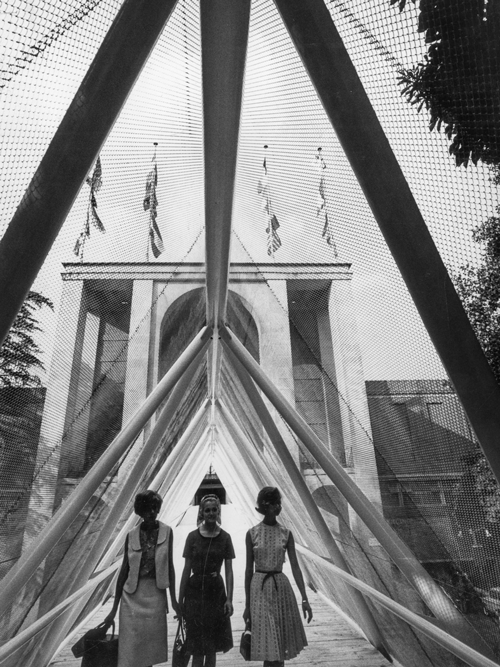
Since 1984, Milan has not seen an exhibition of Alberto Burri’s works. Actually, in 1989, the artist stated he would never exhibit in Milan again, openly crossing sword with the city council that had given authorisation to destroy Teatro Continuo, an installation designed by Burri in Parco Sempione for the XV Triennale in 1973.
This attaches special importance to the tribute paid by La Triennale to the artist, not least because it will exhibit the Neri cycle (1986-1987), cellotex works that have never been exhibited anywhere before, and the Architetture con cactus cycle (1991) that was publicly presented in Athens in 1992 and at the Institute of Italian Culture in Madrid between the late 1994 and the early 1995, but is unknown to the Italian public.
The exhibition covers two floors for a total surface of 2500 square metres.
The exhibition runs through all of the artist’s periods and is laid out in chronological order.
Starting from the ground floor, the first six rooms provide an overview of the painter’s early works: his tars, moulds, hunchbacks, bags, woods and irons and combustions.
These works lay the foundations for the creations made by the artist in the last twenty years: the Cellotex, which are explored in their multiple aspects and displayed in the rooms on the ground and first floors.
The early Cellotex are fully painted, while in the later ones the backings show through and thus become an integral part of the work, the same colour as the material, substantially contributing to the pictorial composition.
The final stage of this section showcases some cellotex with gold leaf accents: they shines in the mat black surfaces of the 1993 Nero e Oro series and highlights therough cracks of the crevices in the 1994 Cretto Nero e Oro series.
On the first floor stands out the Architetture con cactus cycle, composed of ten 2.50 x 3.50 m cellotex and the Neri cyvle, composed of ten 1.30 x 2.50 m cellotex.
These are large-size works that shed light on the last years of Burri’s career and have been selected for the larger areas of La Triennale, considering the artist took care of designing his works according to the size of the areas in which they had to be exhibited.
Burri is responsible for the revolutionary worldwide innovation of using non-pictorial materials that have influenced art to these days.
The painter gave no preference to any material over another: the features of the painting do not depend on the quality of the materials but are to be found in the form and space. Colour is important too for Burri who likes primal colours better than natural ones, including black. The artist works on the contrasts he can create either with the colours of the materials he uses or by playing with different textures.
The exhibition also presents a fairly unknown side to the artist: Burri as a stage designer, with the sketch for Spirituals (1963), a show for which he designed the stage and costumes, the first time the artist worked at La Scala in Milan, the sketch for the ballet November steps (1972), on loan from Rome’s Opera Theatre, the 1975 sketches for Wagner’s Tristan and Isolde, and the photo shoots for these shows.
In addition, the exhibition showcases part of the artist’s mass production. Burri was a great experimenter, even in graphic design, as proven by his Monotex, assemblages of cards directly made by the artist without the mediation of a printer.
Another section of photos and videos by some of the most famous art photographers and directors provides a picture of Burri the man, as he creates with fire and in some moments of his private life, plus a detailed documentation on two exhibition areas of Fondazione Burri, which was created by the artist in his home town: Città di Castello.
Alberto Burri
11 November 2008 – 8 February 2009
Triennale di Milano
Curators: Maurizio Calvesi and Chiara Sarteanesi
Catalogue published by Skira
Open 10.30 am – 08.30 pm, closed on Mondays
Admission: 8/6/5 Euros
To download texts and pictures, visit www.triennale.it/press